
Survivors Blog: Troy
Troy
Alumnus who has been both betrayer and betrayed. A believer that our journeys of healing are ongoing because the destination is us. Helping each other along the road, sharing the load — using our own pain to help someone else is what helps each of us the most.
Breaking the Relapse Cycle: What Being a Betrayer and Betrayed Taught Me
 I’ll never forget the look on my wife’s face the day she discovered my infidelity. The betrayal, the disbelief, the agony...as everything she thought was true in the world and everything she thought was good in her life was jerked out from under her. The look in her eyes haunts me, and always will.
In six years at Affair Recovery and after leading nearly two dozen Hope for Healing groups, I have found the above statement (or words to that effect) to be virtually universal among the unfaithful men I have accompanied on the first steps of their journey to recovery. It is true for me as well—but on more levels than for many in my situation.
My wife and I had been married for eight years and had a six-year-old child when I started an online affair (it was the early days of the internet), which became a physical one with a younger woman. I had left my computer open when I went to work, and my wife saw all my conversations—explicit conversations that would later become known as “sexting”—with my affair partner. When I pulled into the driveway that day, she was sitting on the front stoop, crying. I had no idea what could be wrong. I rushed forward to comfort her. When she looked up at me and I saw the pain in her eyes, I immediately knew what had happened.
But I was caught up in the limerence. I was convinced I was madly in love with this young woman I barely knew and could not give her up. I announced I was going off to start a new life with her and left our home to meet with her, thinking I would never come back. Within a couple of days, I realized what a mistake I had made, and I called my wife and begged her to let me come home. She did, and I never saw the affair partner again. The day I came home into my wife’s arms was one of the happiest moments of my life, and I was so incredibly grateful to be there. I swore I would never do anything like that again, and I meant it. I felt like we had a new start.
But as we all know, it’s not that easy.
We attended couples counseling. As betrayers tend to do, I spent most of the sessions deflecting, justifying, and shifting blame. If only she had met my needs better. If only this, if only that. She grew ever more distant. Within a year or so, I suspected—accurately, as it turned out—that she was having an affair herself. I caught her the way she had caught me. I had never known such pain. I cried bitterly; I screamed and keened like a wounded animal. When my throat was too raw to scream anymore, I kept screaming on the inside for what felt like forever. We reconciled—or tried to—but we began a long, spiraling dance, cheating on each other over and over for the next six years. Finally, she found someone she wanted to start over with and left for good. Despite all the ways we had hurt each other, I was devastated. I knew it was me who had started the chain reaction and that I deserved what I was feeling far more than she did. I swore I would never cause such pain to someone I loved ever again.
And I meant it.
Three years later, I remarried, and we were incredibly happy together. Seven years into our marriage, I reconnected with an old girlfriend online. We spent a lot of time reminiscing about the year we had dated (after my first marriage) and the abrupt way things had broken off (with her cheating). We met for coffee, and the spark was still there. Soon we were texting back and forth all day long, every day, sharing every thought and each day’s mundane events. She was also with someone now—but before long, we were talking about how much we loved each other and always would. And then we were talking in detail about the things we used to do sexually and the things we’d still like to do. Neither of us, though, wanted to leave our partner—we had grown codependent and had become one another’s fantasy escape release valve. We occasionally met in person, usually in public places. I deluded myself into thinking that because it was only words and not physical actions, I wasn’t cheating.
About a year after my emotional affair began, I started to suspect my wife was being unfaithful. By this time, I knew all the signs inside and out, from both sides. I managed to get access to her iPad and learned that she had been meeting other men on an “adultery” website. Once again, I was devastated—far more so, in fact, than in my first marriage. I would never have believed my current wife capable of betrayal. She was the one woman I had trusted completely (just as I was the one man she had trusted). I recognized the irony of that, considering my own ongoing secret relationship. She was racked with guilt when discovered, and I realized how much I loved her and wanted to be with her forever.
But I didn’t end my emotional affair. If anything, I doubled down on it, using my wife’s infidelity as justification for trying to have my cake and eat it, too. Until two years later, that is—when I was discovered. Shortly after that, my wife and I found Affair Recovery and EMS Online, and later Harboring Hope and Hope for Healing (when I relapsed a year after D-Day).
I have been married twice, and in both marriages, I was both the betrayer and the betrayed. It is a depth of experience no one would wish for, but knowing so intimately what it feels like to be betrayed has helped me in my efforts to bring empathy for both roles into my discussions with the groups I lead.
It also provides an object lesson. At the end of my first marriage, I was crushed by the pain I had caused and sincere in my commitment never to do it again—but I did not address the core issues that had led me down the path of betrayal in the first place, thus virtually guaranteeing that I would do it again. “It’s your best efforts that got you here.”
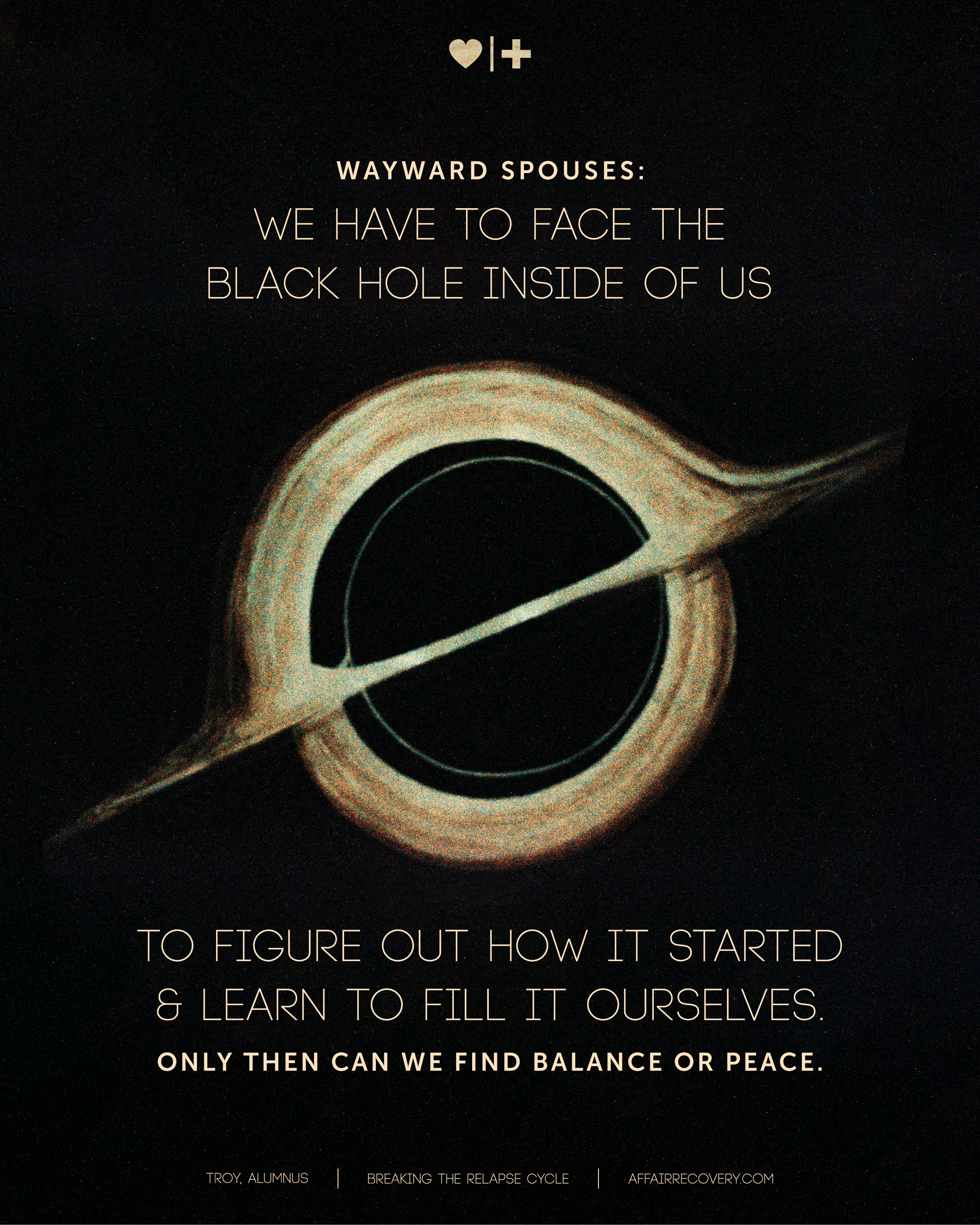
What I have learned in the years since—through Affair Recovery and my own therapy—is that many of us carry a black hole inside us. It sucks everything in. We’ve usually carried it since childhood, and we spend our lives trying to fill it—through other people, through addictions, or through both. But no one person can make you happy. No one human being can fill that emptiness. We have to face the black hole, figure out how it started, and learn to fill it ourselves. Only then can we find balance or peace.
But you know what? No one can do it for you, but those of us who have been there can help you learn to do it for yourself and walk you through the first steps of the journey until you can stand on your own.
And that can make all the difference.
I’ll never forget the look on my wife’s face the day she discovered my infidelity. The betrayal, the disbelief, the agony...as everything she thought was true in the world and everything she thought was good in her life was jerked out from under her. The look in her eyes haunts me, and always will.
In six years at Affair Recovery and after leading nearly two dozen Hope for Healing groups, I have found the above statement (or words to that effect) to be virtually universal among the unfaithful men I have accompanied on the first steps of their journey to recovery. It is true for me as well—but on more levels than for many in my situation.
My wife and I had been married for eight years and had a six-year-old child when I started an online affair (it was the early days of the internet), which became a physical one with a younger woman. I had left my computer…
Continue reading →
From Triggered to Solid: How Unpacking Your Childhood Trauma Helps Your Spouse Heal
Continue reading →
Literally Broken: What It Took to Take Recovery Seriously
 Most people do everything they can to avoid rock bottom. But sometimes, it takes a violent collision between our pride and our reality to finally wake us up. In
Hope for Healing, we frame brokenness not as destruction, but as a turning point—the moment you stop pretending you have everything under control, step out of the self-centered box, and open yourself to true empathy.
The guys in the group are asked to reflect on the best example of brokenness they can think of in their own journey of healing. I always share mine with them, because it is literal as well as metaphorical, and is therefore a powerful way to demonstrate the point.
I started Hope for Healing in late July, 2020, when I had relapsed eighteen months after D-Day. We got to the brokenness chapter in early September. One Thursday night in the first week of that month, I had to do a sleep study. If you’ve never had one, they put you in a surreal room—part hospital, part hotel—and hook you up to a web of wires and monitors. I barely slept. They released me at 7:00 AM, giving me just enough time to run home, shower, and head to work.
When I got home, I found my wife already flooding. A female French-Canadian acquaintance of mine had responded to something I said on Facebook, and had called me "mon ami" (“my friend”). This is very different from “mon amour,” which could be a romantic term. Exhausted, rushed, and stressed, I instantly became frustrated. At that point in my journey, I hadn't yet learned how to handle that level of pressure. My default response to overwhelming frustration was self-harm—beating my head against the wall or pounding my temples with my fists, a reaction that terrified my wife and always escalated the situation.
Trying to escape the pressure, I half-ran to the bathroom. Once out of sight, I started punching myself in the head. Disoriented and moving too fast, I lost my balance, and the bathroom rug slipped out from under my feet.
I fell backwards, hard. Without thinking, I stuck my left arm out to break my fall—and it snapped, right at the shoulder. Broke clean through. My whole arm was hanging from my shoulder by the flesh alone. I screamed bloody murder, and my wife came to help me up. I remember her handing me my arm and driving me to the ER. Unfortunately, rural hospitals often have staffing problems, and this was the Friday before Labor Day weekend. There was no one there who could set my arm, and would not be until the following Tuesday. They sent me home with pain killers, but I had to sit motionless for four days (because the slightest movement was agonizing). My wife had to wait on me hand and foot and help me to the bathroom and back.
When I did get to see an orthopedist, I was admitted to the hospital for surgery to install a steel rod in my arm. I handed my wife my phone as they were wheeling me away, leaving her alone to wait. She went through my phone, which is natural in our circumstances. I had given her all my passwords. What I had not anticipated was her reading through my texts with the accountability partner she had recommended to me, and which we had agreed would be confidential. She did look at them, and as a betrayed spouse, I may well have done the same, and was flooded by the discussions she read.
When I came out of anesthesia, I was greeted by a traumatized wife who now had to act as sole caretaker for the next few weeks for the person who had deeply betrayed her.
And that was the exact week we discussed the brokenness chapter in group.
It got my attention in a way it might not have had it come a few weeks earlier. I was literally broken. Literally helpless. And completely reliant on the person I had betrayed. But I also realized something else.
I’d had a steel rod nailed to my arm, holding it together. It was painful to heal from, agonizing sometimes, and I knew it would leave deep scars. But, once that healing happened, that arm would be much stronger than ever before, and be able to endure much more pressure.
I think that was a turning point for me. I’d agreed to do Hope for Healing to make my wife happy, and to show her I was taking some steps in the right direction, but I had not been taking it as seriously as I should have. I was still deflecting, minimizing, and justifying, thinking this stuff doesn’t really apply to me because, deep inside, I was still telling myself what I had done wasn’t really that bad. But my accident, coming when it did, humbled me. I took my journey very seriously after that. I still had a very long way to go, but it was a start.
How about you? Have you been broken? It is no fun, especially when you caused it yourself. You may not have as literal an example as mine, but I bet everyone reading this can think of a time when they were at that place. The question is, what do you take from it?
When I was young I had a friend and religious mentor who had an affair that became public. He lost his position and was ostracized. I worried about him, but I was also a little hopeful. This man had always had a tendency to be self-righteous and judgmental. I hoped that this experience would humble him and make him have more empathy for others. It had the opposite effect. When allowed to return, he was more judgmental than ever because he was trying to prove he deserved to be back, and that he really was better than those other sinners.
He missed an opportunity to grow, and to truly heal.
Don’t be that guy. If you were unfaithful, pride played a role. Let this horrible, painful fall lead you to a healing that makes you humbler, more loving, and more empathetic.
And stronger.
Most people do everything they can to avoid rock bottom. But sometimes, it takes a violent collision between our pride and our reality to finally wake us up. In
Hope for Healing, we frame brokenness not as destruction, but as a turning point—the moment you stop pretending you have everything under control, step out of the self-centered box, and open yourself to true empathy.
The guys in the group are asked to reflect on the best example of brokenness they can think of in their own journey of healing. I always share mine with them, because it is literal as well as metaphorical, and is therefore a powerful way to demonstrate the point.
I started Hope for Healing in late July, 2020, when I had relapsed eighteen months after D-Day. We got to the brokenness chapter in early September. One Thursday night in the first week of that month, I had to do a sleep study. If…
Continue reading →