
Finding Safety in Numbers: Why an Affair Recovery Group is Vital for Healing



The first time I remember knowing I didn’t belong to the group was in fifth grade.
Alyssa Packson was on the twirling team and head of the student council. Teachers doted on her because she made straight A’s, and the other girls worshiped her—she already had a boyfriend, which, at eleven automatically made her the coolest girl in class.
Two of my close friends were part of her inner circle, so I heard plenty of Alyssa-stories through them. I listened intently when they mentioned she’d be passing out invitations for her end-of-year party.
The next day, Alyssa and her posse strode out the metal doors to the recess yard. Her followers had doubled in size, and they moved across the field like an amoeba—one shifting organism—as she handed out pink folded invitations.
My friend mouthed, “Come here!” and motioned for me to join the group that had begun forming a circle. But as I stepped closer, Alyssa turned toward me. Her lips curved into her gorgeous smile as she said in a sing-song voice,
“Uh-uh, no, Rachel…you’re not in the group. Sorry.”
She turned her back and pulled the circle inward, leaving me motionless on the outside.
What We Carry Into the Circle
I hadn’t thought about that childhood memory in decades, but it came back with surprising force when I considered joining a partner group.
It wasn’t just the image of eleven-year-old Rachel awkwardly shuffling her feet in the dirt behind that circle of girls.
It was also the feeling that came back.
The hollowed-out space in my stomach.
The racing heartbeat.
The words that wouldn’t budge from my mouth.
That old fear of not belonging was still alive in my body.
Part of me felt ridiculous tracing my hesitation back to a pink invitation on a playground. That moment certainly wasn’t the sharpest rejection of my life.
And yet, I had joined countless circles since then–church groups, mom groups, sports teams, book clubs, study groups, even other recovery spaces. I knew how groups worked and how to find my seat.
But this group–this one with women who knew the sound of their world cracking–terrified me.
I was emotionally raw, my skin thin from everything that had happened in my marriage.
I couldn’t risk watching another circle close in front of me.
Not this time.
My husband carried a different fear, though.
His years in the military had given him a kind of belonging I couldn’t fully understand. For him, it wasn’t a fear of being rejected—it was a fear of being exposed.
“You know I don’t like my business being blasted out to a room full of strangers,” he told me, “Plus, I already feel enough shame as it is. I don’t need any more thrown at me.”
When it came to stepping into a group, there was a lot at stake for both of us.
For me—another potential closed circle.
For him—vulnerability that could cost him.
The Search for Safety
As we looked for places to heal, my husband and I quickly realized that not every group is a safe place to land.
There were groups that, quite frankly, did more harm than good. I remember sitting in a space where I left feeling smaller than when I walked in–where stories were compared like a scorecard and advice rushed in before any connection had been built. In those rooms, “fixing” replaced listening, and I felt that old fifth-grade part of me standing on the outside. But then, we found the spaces that were different.
When my husband’s therapist encouraged him to join a specific men’s infidelity group, he reluctantly said yes. Week after week, he sat in a circle of men who told the raw truth about their lives. Some wept, some sat expressionless, but the collective honesty disarmed him. He discovered that the more he listened, the less the room felt like a firing squad and more like a mirror. He was finally allowing himself to be known, and in being known, the shame began to lose its grip.
For me, belonging grew quietly during my Harboring Hope group, beginning with the way our facilitator invited us to connect on the online wall before the weekly calls started. We shared a little about ourselves–our hobbies, our children, and the parts of our lives that existed outside the betrayal.
During our first meeting, we were each invited to give a five-minute overview of our story and what had brought us there. At the start of every call, we also revisited the group agreements: no interrupting, no fixing, and no cross-talk. Those commitments helped create safety and shaped the tone of the group.
When it was my turn to share my story, my voice shook as I spoke. But as the words came out, no one rushed to correct my story or offer advice. The group simply listened. I shouldn’t have been surprised–we had all agreed to offer that kind of space to one another–but when it was extended to me, it meant more than I expected.
Something in me settled.
The circle wasn’t closing on me.
It was widening.
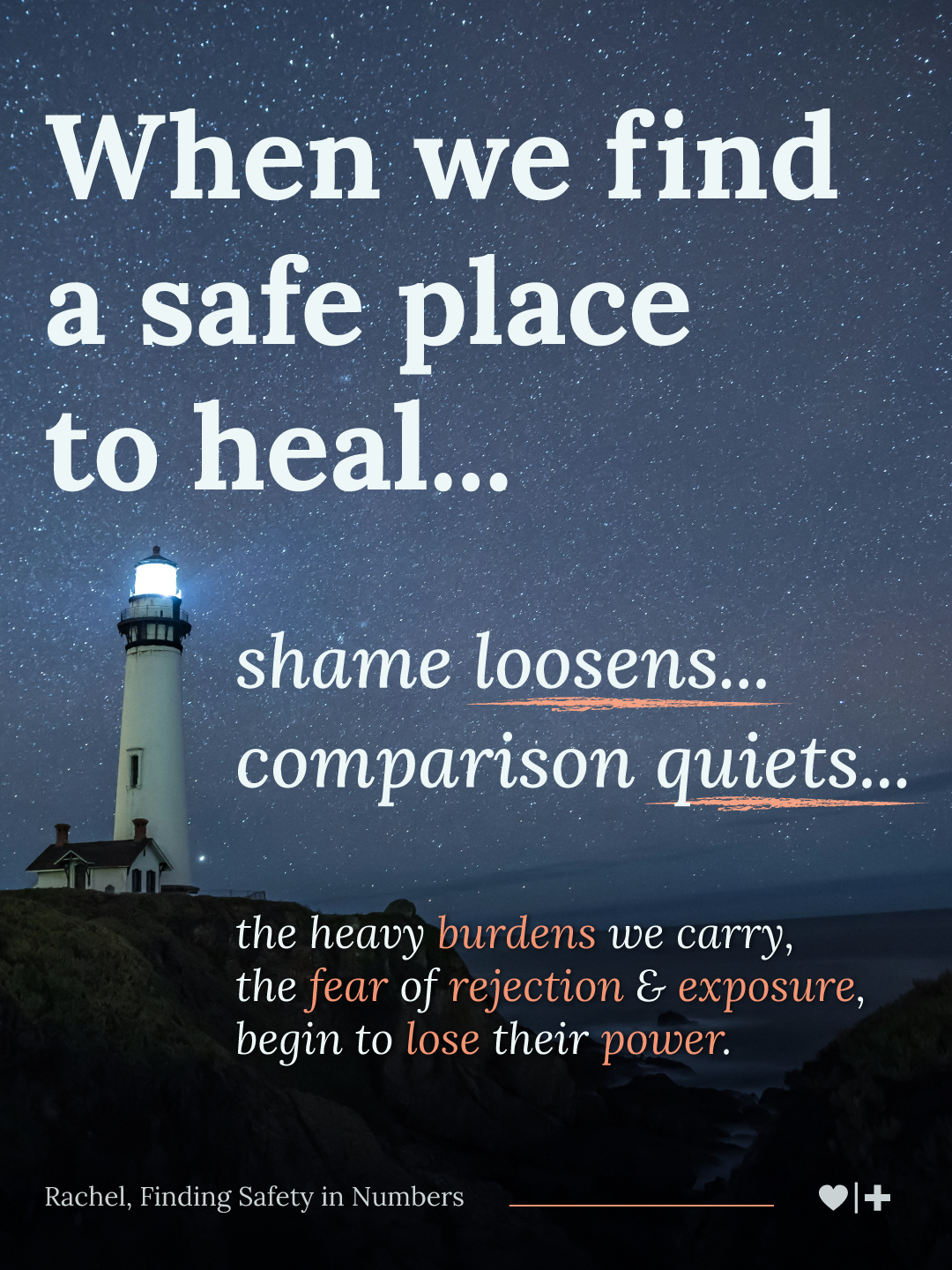
And when the circle stays open, the heavy burdens we carry–like the fear of rejection and exposure–begin to lose their power.
Shame loosens. Comparison quiets.
We remember we aren’t walking this path alone.
And sometimes, that’s where the real healing happens.
If you’ve been navigating recovery on your own–or if previous group experiences haven't felt safe–consider programs like Harboring Hope, Hope for Healing, and EMS Online. These are designed to create the kind of trauma-informed spaces where circles widen instead of close.
What type of affair was it?
What to read next
Free Surviving Infidelity Bootcamp


Add new comment